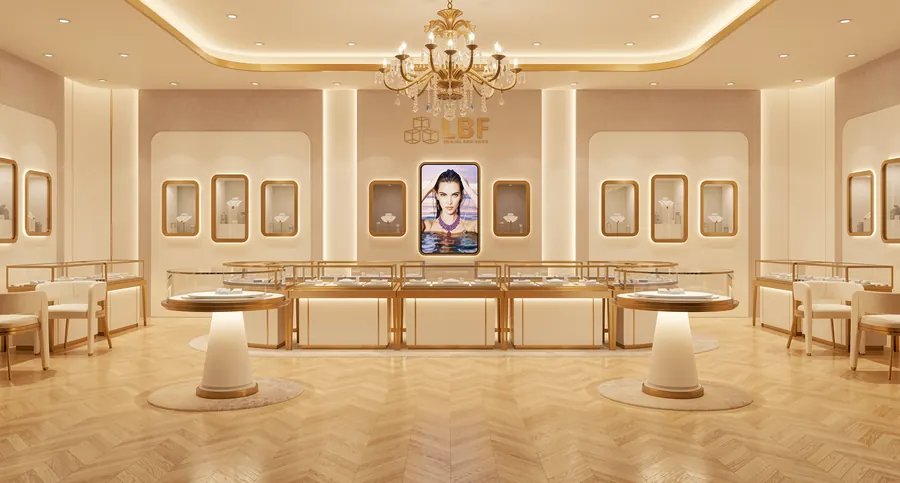
A 30–60㎡ jewelry store is not a compromise — it is a discipline. In a space this size, every centimeter either sells or costs you money. The good news: some of the highest-performing jewelry retailers in the world operate in footprints under 60㎡, because a tight floor plan forces clear decisions about circulation, lighting, and display density. Whether you are opening your first store, relocating to a mall unit, or renovating an existing boutique, the goal is the same: make the customer move naturally toward the counter, keep their eyes on product, and give staff room to close the sale. Below are practical, numbers-first strategies for small jewelry store design that hold up in real retail conditions.
Start With the Sales Zone, Not the Decor
Before choosing finishes, draw the customer path. In a 30–60㎡ store you have room for three functional zones and little else: an entry decompression area (2–3㎡), a main display and sales counter zone (10–16㎡), and a consultation or seating zone near the counter (2–4㎡). Aisle width matters more than most owners expect — plan for 900–1,100 mm of clear walking space on the primary path. Narrower than 800 mm and two customers cannot pass each other comfortably, which kills browsing behavior at peak hours.
Place the main counter at roughly 60–70% of the store depth, not at the back wall. This pulls customers inward while keeping the counter visible from the entrance, and it leaves a small area behind or beside it for staff movement, packaging, and a safe. In a 40㎡ store, allocating 14–16㎡ to the counter and wall display zone is a realistic target; pushing it to 20㎡ usually means the entry feels cramped.
Use Vertical Space Instead of Floor Space
The most common mistake in small jewelry store design is horizontal thinking. When floor area is fixed, vertical wall space is your cheapest expansion. A wall that is 3 meters wide and 2.6 meters high gives you roughly 7.8㎡ of display surface — far more than any floor-standing unit can offer in the same footprint.
Build in three visual bands:
- Eye level (1,400–1,700 mm): hero pieces, new collections, highest-margin items.
- Chest to eye level (1,000–1,400 mm): core inventory — rings, pendants, bracelets.
- Below 1,000 mm: drawers, stock drawers, and lower-value or seasonal items; keep it closed rather than open where possible.
Glass shelving at 300–350 mm depth is normally enough for jewelry. Deeper shelves waste space and encourage clutter. If your ceiling allows, a wall vitrine that runs full height with lockable lower cabinets effectively doubles storage without adding a single square meter to the lease.
Choose Showcase Types That Fit Tight Layouts
Not every showcase works in a small boutique. Freestanding island cases at 1,200 × 600 mm can dominate a 35㎡ floor, while a well-specified wall case or counter case does the same selling job in less depth. Typical specifications that work well in compact stores:
- Counter showcases: 1,000–1,400 mm long, 550–600 mm deep, 950–1,000 mm high — the workhorse unit for staff-assisted selling.
- Wall vitrines: 800–1,200 mm wide, 300–400 mm deep, mounted or built in, with LED strips at the front and rear of each shelf.
- Corner units: use the 90° wall intersection; a corner case can recover 0.5–0.8㎡ of otherwise dead space.
- Slim tower cases: 400–500 mm square footprint for a single hero item or a promotional display.
Glass thickness matters for security and clarity: 8–10 mm tempered glass is standard for counter tops, with laminated glass on external glazing. Locking systems, whether central cam locks or sliding rail locks, should be consistent across units so staff do not fumble during a busy Saturday.
Lighting Is the Difference Between Selling and Displaying
In jewelry retail, lighting does more work than any finish. Aim for high color rendering — CRI 90 or above, ideally 95 — and a color temperature between 3000K and 4000K. Warm-neutral light flatters gold and gemstones; too cool and diamonds look flat, too warm and white metals turn yellow.
Target illuminance of 1,000–2,000 lux on the display surface, with accent ratios of 3:1 to 5:1 against ambient light. This contrast is what makes a piece pop. Use LED strip lighting built into each shelf front and run dimmable circuits on separate zones — window, wall, counter — so you can adjust through the day. Avoid putting heat-generating halogen lamps inside a sealed showcase; in a 50㎡ store, thermal buildup affects both product and comfort.
Design for Two Customers and Two Staff
Small stores live or die on circulation during peak moments. Test your plan against this scenario: two customers browsing the wall, one seated at the consultation table, one staff member at the counter, one staff member moving between stock and counter. If that scenario blocks the entrance or traps a customer behind a case, the layout needs revision.
Keep the consultation zone slightly separated — a 1,200–1,400 mm table with two chairs needs about 2.5㎡ including pull-out space. Position it where the customer faces away from the entrance, which reduces distraction and signals a private, high-value conversation. For security, ensure there is one clear line of sight from the counter to the door, with no tall fixtures blocking it.
Storage is the invisible requirement. Budget roughly 0.5–1.0㎡ of back-of-house or hidden storage per 10㎡ of sales floor. Without it, boxes, packaging and cleaning supplies migrate under the counter and onto display surfaces, which visibly cheapens the store.
Materials and Finishes That Keep Small Spaces Feeling Open
Light-toned walls, mirrored or high-gloss panels used sparingly, and a continuous floor material make a 40㎡ room read larger. Dark, heavy joinery around a showcase can make a small store feel like a vault. A practical palette: neutral wall paint or micro-cement, a mid-tone floor in matte porcelain or engineered wood, and showcase bodies in a restrained finish (satin brass, brushed steel, matte lacquer) so the products remain the brightest objects in the room. Keep the visual count of materials to three or four; more than that and the space feels busy instead of considered.
Libafang Showcase Co., Ltd. manufactures custom display showcases and has supplied jewelry stores, watch boutiques and museums in more than 30 countries, which means we see a lot of compact floor plans and know what actually ships and installs cleanly. For owners working within 30–60㎡, the right case dimensions, lighting zones and locking details usually save more money than any decorative upgrade.
If you are planning a small jewelry store, send us your floor plan and product mix. We will prepare a free design proposal and quote tailored to your space, including recommended showcase sizes, glass specifications and lighting layout.