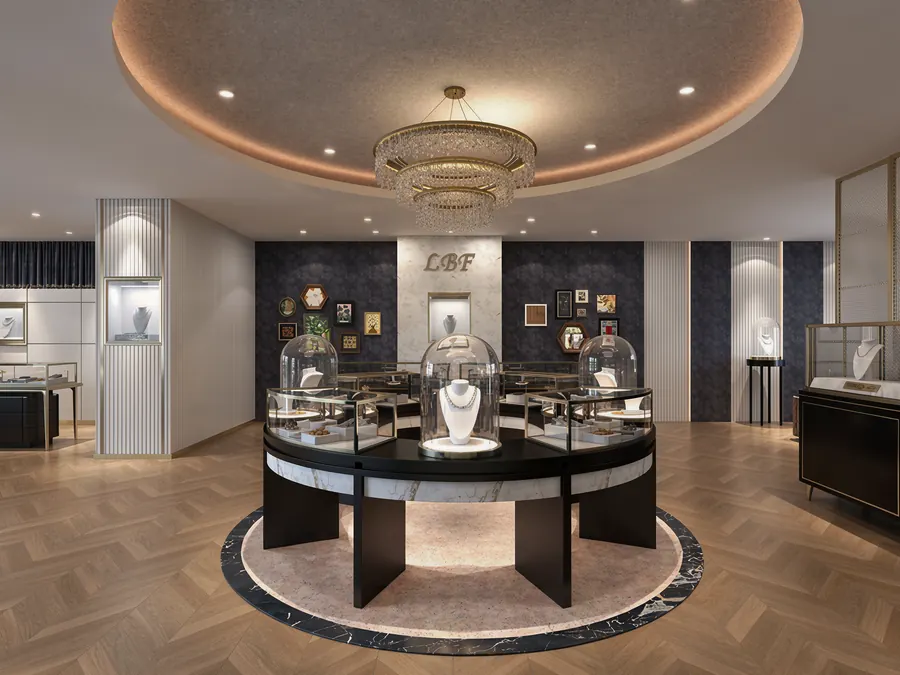
A custom logo display counter is more than a place to set a tray. In a jewelry store or watch boutique, the counter is where 60–80% of closing conversations happen, so every square centimeter of its front face, countertop edge and riser is working space for your brand. The practical question is not whether to add branding, but where to put it, what material to use, and how to keep the structure strong enough to last a decade of daily use. This guide covers the decisions that actually change cost, lead time and appearance.
Why the Counter Is the Highest-Value Branding Surface in the Store
Shoppers read the counter before they read the wall graphics. The average customer stands within 60–90 cm of a display counter for 3–8 minutes per visit, which is far longer than they spend looking at a logo behind the register. That proximity makes the counter front the best surface for sharp, repeatable logo reproduction — you can hold tolerances of ±0.5 mm on an engraved panel, while wall signs are usually viewed from 2–3 meters away and can tolerate more.
There is also a legal benefit. For multi-brand retailers, a consistent logo panel on each counter clarifies which brand owns which display zone, which reduces mix-ups when staff swap trays between counters. For single-brand boutiques, the counter becomes the anchor that makes an entire floor feel designed rather than assembled.
Five Ways to Apply a Logo to a Display Counter
Each method has a different cost band, durability profile and lead-time impact. The numbers below are typical for a 1200 × 600 mm counter, the most common size in jewelry retail.
- Laser-engraved acrylic panel: 3–5 mm cast acrylic, back-filled with paint for a frosted, dimensional effect. Cost roughly USD 25–45 per panel; adds 2–3 days to production. Best for backlit or side-lit counters.
- Brushed stainless or brass plaque: 1.2–1.5 mm brushed 304 stainless with laser cut edges. Cost USD 40–80 per panel depending on thickness and finish. Excellent for watch boutiques where metal texture matches the product.
- UV-printed graphic panel: direct printing on 5 mm foam PVC or acrylic with a matte laminate. Cost USD 15–30 per panel, full color, unlimited artwork. Good for seasonal campaigns but thinner scratch resistance.
- Inlaid veneer or solid wood: 0.6 mm wood veneer or 4 mm solid walnut inlaid into an MDF substrate. Cost USD 50–110 per panel because of handwork. Suitable for museums and heritage brands.
- Backlit 3D lettering: 10–20 mm aluminum channel letters with hidden LED modules at 12V, 4000K. Cost USD 90–180 per set; adds 4–6 days. Highest visual impact but needs a routed channel and clearance behind the front panel.
Where to Place Logo Panels Without Weakening the Structure
Counter fronts are usually a frame plus infill panel, so cutting into them needs care. Three placements work reliably:
Recessed front panel: route a 4–6 mm deep pocket into the front face, then insert the logo panel flush or 1 mm proud. This keeps the outer frame intact and allows panel replacement if branding changes. It is the safest option for counters that ship flat-packed.
Countertop edge band: a 40–60 mm tall strip along the top edge, engraved or printed. It is visible from standing height, but you lose roughly 5% of usable writing space on the countertop, so reserve it for logo-only applications without taglines.
Riser or end gable: the vertical side panel facing the aisle. This is the most underused surface. A 300 × 300 mm engraved plaque on the end gable is visible from across the store and does not disturb the working surface at all.
What does weaken a counter is cutting through a load-bearing frame member or removing more than 20% of the infill panel area. Keep openings within the panel field, leave at least 40 mm of material around any cutout, and never place a recessed panel directly under the display surface where telescoping risers bear weight.
Materials, Color Matching and Lighting
Color matching is where most projects lose time. For brushed metal, specify the grain direction and the target Rz surface roughness (typically Rz 0.8–1.6 µm) rather than a vague “brushed” description. For painted panels, send a physical chip; screen colors never match perfectly across a gloss lacquer finish.
Lighting choice changes perceived color. Backlit logos at 4000K read neutral and make silver jewelry look clean, while 2700K tends to push warm tones into white gold and can make it look yellow. For acrylic panels, ask for a 30–50% light diffusion layer so the LED pitch does not show through the logo.
Production, MOQ and Lead Times
Logo detailing is usually quoted as an add-on, not a separate product. Typical terms for export orders:
- Tooling or engraving setup: one-time cost of USD 80–200 depending on artwork complexity.
- Minimum order quantity: from 5–10 counters for a repeated logo panel, or 1 unit if you accept a higher per-unit setup charge.
- Sampling: 5–7 days for a physical logo panel sample before full production.
- Full production: 15–22 days for 20–50 counters including panel assembly and QC.
- Export packing: each panel wrapped in PE film, corner-protected and crated separately to avoid transit scuffs.
Ask for the logo panel as a separate line item on the quotation. It simplifies future re-orders: if your branding changes in three years, you order new panels instead of new counters.
What to Send for an Accurate Quote
You will get a faster, tighter quote by providing: vector artwork (AI or SVG), the exact placement dimensions on the counter drawing, the finish type from the list above, the lighting temperature if backlit, and the target destination port. With those five items, a Guangzhou-based manufacturer such as Libafang can usually confirm feasibility and pricing within 24–48 hours. Libafang builds custom display counters and showcases for jewelry stores, watch boutiques, museums and luxury retail, exporting to more than 30 countries, and treats logo panels as an integrated part of the counter rather than an afterthought.
If you are planning a store rollout, the branding layer is worth deciding early — before the counter drawings are finalized. That is when recess depths, channel clearances and lighting runs can be designed in at almost no extra structural cost.
Ready to see how your logo looks on a counter? Send us your artwork and counter layout to request a free design and quote from Libafang today.