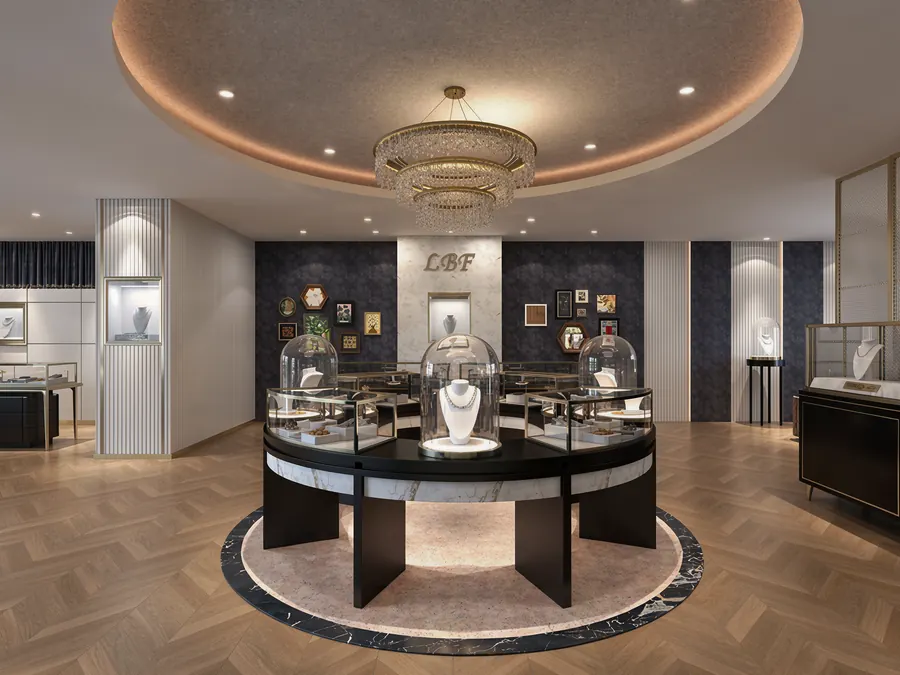
When you walk into a museum or luxury boutique, the lighting does two jobs at once: it makes objects look extraordinary and it keeps them safe from damage. That balance is the essence of museum-grade lighting. Get it wrong, and you either wash out details or slowly destroy what you are trying to display. Get it right, and a 200-year-old silk textile or a diamond-set watch can be viewed for decades without measurable harm. This article breaks down the science and practice of museum-grade lighting so you can specify, buy, or design showcases that protect while they impress.
What Makes Lighting ‘Museum-Grade’?
Museum-grade lighting is not just bright or expensive. It is a set of measurable performance criteria that limit damage and maximize visibility. The core parameters are:
- Illuminance (lux): The amount of light hitting a surface. Museums typically keep sensitive materials between 50 and 200 lux. For comparison, a typical office is 300–500 lux, and direct sunlight can exceed 100,000 lux.
- UV radiation: Ultraviolet light causes fading and embrittlement. Museum-grade fixtures should emit less than 75 µW/lumen of UV, and ideally under 10 µW/lumen for textiles, watercolors, and feathers.
- Color rendering index (CRI): A CRI of 90+ is standard; 95+ is preferred for jewelry and fine art. R9 (deep red) should be above 50 for accurate skin tones and ruby/garnet stones.
- Color temperature (CCT): 3000K–4000K works for most artifacts. Warmer (2700K–3000K) suits gold, wood, and historic interiors; cooler (3500K–4000K) suits silver, platinum, and scientific specimens.
- Infrared (IR) radiation: IR heats objects and causes drying. Modern LEDs emit negligible IR, unlike halogen.
- Glare and contrast: Unified glare rating (UGR) below 19 is recommended for viewing areas. Excessive contrast hides detail in shadows or blows out highlights.
These numbers are not arbitrary. They come from conservation research by institutions like the Canadian Conservation Institute and the Getty Conservation Institute. If a fixture does not meet them, it is not museum-grade—no matter what the marketing says.
The Damage Mechanism: Why Light Is Not Neutral
Light is energy. When photons hit a material, they can break chemical bonds. The three main damage pathways are:
- Photochemical damage: UV and short-wavelength visible light (especially blue light around 400–450 nm) trigger fading and yellowing. This is cumulative and irreversible.
- Thermal damage: Infrared and high lux levels raise surface temperature, causing cracking, warping, and accelerated aging. A 5°C rise can double the degradation rate of some organic materials.
- Photomechanical damage: Light can cause physical stress in materials like parchment and some plastics, leading to micro-cracks.
The practical takeaway: you cannot eliminate damage entirely, but you can slow it dramatically. Reducing lux from 200 to 50 cuts photochemical damage to one-quarter. Eliminating UV removes the most aggressive part of the spectrum. Using LEDs instead of halogen removes almost all IR heat.
Lighting Strategies for Different Artifacts
Not all objects tolerate the same exposure. Conservation guidelines group materials by sensitivity:
- High sensitivity (50 lux max): Textiles, costumes, watercolors, manuscripts, prints, feathers, fur, botanical specimens. UV should be below 10 µW/lumen.
- Medium sensitivity (150–200 lux max): Oil paintings, tempera, wood, leather, ivory, bone, some plastics. UV below 75 µW/lumen.
- Low sensitivity (300 lux max): Stone, metal, glass, ceramics, gemstones (except those with organic inclusions or surface treatments). UV still matters for any organic mounting or adhesives.
For mixed displays—common in jewelry boutiques—use zone lighting. A necklace with pearls (high sensitivity) might need 50 lux, while the gold chain (low sensitivity) can take 300 lux. Adjustable LED spotlights with separate dimming channels let you meet both needs in one case.
LED Technology: The Current Standard
LEDs have largely replaced halogen and fluorescent in museum environments for three reasons: no UV, no IR, and precise dimming. But not all LEDs are equal. Look for:
- Bin-selected LEDs with consistent color temperature and CRI across the batch. A 3-step MacAdam ellipse is standard; 2-step is better for critical color matching.
- Remote phosphor or multi-chip designs that maintain color stability over time. Cheaper LEDs shift color as they age.
- Flicker-free drivers with a ripple below 1%. Flicker is invisible but causes eye strain and can interfere with video recording.
- Thermal management: A good heat sink keeps junction temperature below 65°C, preserving both LED life and artifact safety.
- Optical control: Interchangeable lenses (10° to 60°) and snoots to shape the beam and avoid spill.
At Libafang, we integrate these LED systems into custom showcase designs for jewelry stores, watch boutiques, and museums. The goal is to match the light to the object, not the other way around.
Case Design and Light: The Invisible Factors
Lighting performance depends on the case as much as the fixture. Three details matter:
- Reflectance: Interior surfaces should be matte and neutral (18% gray or less) to avoid color casts. High-gloss white or black creates hotspots and false color.
- Sealing: Dust and humidity degrade light output and damage artifacts. A well-sealed case with desiccant keeps lux levels stable and protects sensitive materials.
- Ventilation: Even LEDs produce some heat. Passive vents or low-noise fans keep temperature rise under 2°C above ambient.
If you are retrofitting, measure first. A lux meter costs under $100. Take readings at the object surface, not at the light source. Check UV with a simple UV card or a meter. You will often find that existing lighting is 2–5 times too bright for the artifacts on display.
Practical Steps to Specify Museum-Grade Lighting
- Classify your artifacts by sensitivity (high, medium, low).
- Set lux limits for each zone based on conservation guidelines.
- Choose LEDs with CRI 95+, CCT 3000K or 3500K, and UV < 10 µW/lumen.
- Design the beam to cover only the object, not the background or viewers’ eyes.
- Install dimming (0–100% or 1–10V) to adjust for different objects and times of day.
- Test and document lux, UV, and color temperature at the object surface before opening to the public.
Doing this upfront costs 10–20% more than off-the-shelf lighting, but it extends the life of your collection and avoids the reputational cost of visible fading. For a jewelry store, it also means diamonds sparkle without frying the silk display pad.
Ready to light your artifacts properly? Libafang Showcase Co., Ltd. designs and manufactures custom museum-grade display cases with integrated lighting. We ship to 30+ countries and can provide a free design and quote based on your specific objects. Contact us with your project details.