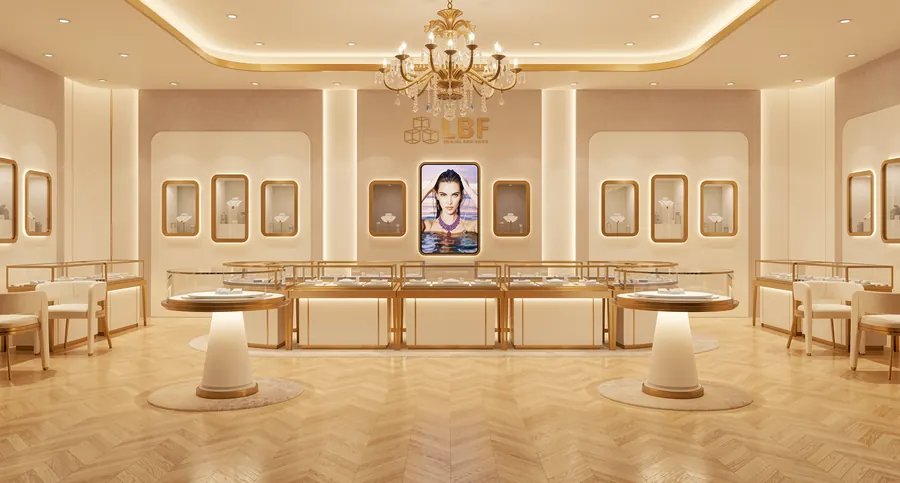
Jewelry displayed in a showcase is exposed to air, humidity, and pollutants 24 hours a day. For silver, copper, and brass items, that exposure leads to tarnish—a thin layer of corrosion that dulls the finish and devalues the piece. Retailers and museum curators cannot simply polish every item daily; they need showcases that actively slow or prevent tarnish. The right anti-tarnish jewelry display strategy combines material selection, case sealing, and replaceable scavenger media. This article explains the science behind tarnish, compares proven materials with concrete performance data, and shows how to integrate them into custom showcase designs.
What Causes Tarnish in a Display Case?
Tarnish is a chemical reaction. Silver reacts with sulfur-containing gases—hydrogen sulfide (H₂S) and carbonyl sulfide—to form black silver sulfide (Ag₂S). Copper and its alloys (brass, bronze) react with oxygen, chlorides, and sulfur compounds to form green or brown patinas. Humidity accelerates every one of these reactions. Above 60% relative humidity (RH), tarnish rates on silver can increase 3–5 times compared to 40% RH. Airborne pollutants from rubber bands, cardboard, some woods, and even staff perfumes release sulfur compounds that plate onto metal surfaces within days.
A display case is a micro-environment. Without intervention, it traps pollutants and moisture, making tarnish worse than open-air storage. Effective anti-tarnish design does three things: blocks pollutant ingress, controls humidity, and continuously scavenges reactive gases.
Core Anti-Tarnish Materials and How They Perform
Not all materials are equal. The table below summarizes the most common options used in professional showcases, with typical performance figures based on industry testing.
- Pacific Silvercloth (or equivalent sulfur-absorbing cloth): Woven fabric impregnated with fine silver particles. It absorbs sulfur gases and protects silver for 6–12 months in a sealed case. When the cloth darkens, it is saturated and must be replaced. Cost: moderate. Best for drawer liners and wrapped trays.
- Activated carbon filter media: High surface area (500–1500 m²/g) adsorbs organic vapors and sulfur compounds. Works best in forced-air or passive vented systems. Replacement interval: 3–6 months. Does not control humidity.
- Silica gel desiccant: Reduces RH to 40–45% when properly sized at 1 kg per cubic meter of case volume. Indicator types change color at 50% RH. Regenerate at 120°C for 2 hours or replace every 2–3 months.
- Zeolite and molecular sieve: Selective for H₂S and small polar molecules. Capacity roughly 10–15% of carbon by weight for sulfur gases, but less affected by humidity. Suitable for long-term museum enclosures.
- Anti-tarnish foam and felt: Polyurethane or EVA foam impregnated with copper or silver salts. Protects tools and trays but has limited total capacity—typically 3–6 months in a closed case. Choose sulfur-free formulations.
- Barrier films and gaskets: Aluminum-coated PET film or butyl rubber gaskets reduce air exchange rate to under 0.5 air changes per day. This multiplies the life of any scavenger material by 4–10 times.
For most jewelry retail showcases, the best result comes from combining a barrier (gaskets), a desiccant (silica gel), and a scavenger (activated carbon or silver cloth).
Museum-Grade vs. Retail-Grade Anti-Tarnish Solutions
Museums often demand ISO 18916 or ANSI/NAPM IT9.16 compliance for photographic and metal artifacts, which translates to pollutant levels below 0.1 µg/m³ for sulfur compounds. Retail showcases rarely need that level. A pragmatic retail specification is:
- Case tightness: air exchange rate below 1.0 per day (gasketed doors, no open cable ports).
- Humidity: maintained at 40–50% RH using 1 kg silica gel per m³ of internal volume.
- Scavenger: one 100 g activated carbon pouch per 0.5 m³, replaced every 4 months.
- Interior materials: sulfur-free foams, powder-coated steel (not raw), and low-emission adhesives tested to ISO 16000-9.
This combination extends time-to-visible-tarnish on sterling silver from about 2 weeks (unprotected case) to 9–12 months. For gold and platinum, tarnish is rarely an issue, but the same system prevents discoloration of lower-karat alloys and protects gemstones from dust.
Designing Anti-Tarnish Features into Custom Showcases
Retrofitting a standard case is difficult and often ineffective. The better path is to specify anti-tarnish features during fabrication. Key design decisions include:
- Sealed gasket channels: EPDM or silicone gaskets with 30–40% compression set resistance. Avoid PVC gaskets, which can release plasticizers.
- Isolated electrical compartments: LED drivers and wiring produce heat and outgassing. Place them outside the display volume or seal them separately.
- Scavenger access ports: Small hinged panels that let staff replace desiccant and carbon without opening the main case.
- Material compatibility: All adhesives, paints, and fabrics should pass a 14-day silver coupon test (ASTM D130-04 equivalent) before production.
At Libafang, we build these features into every custom jewelry showcase project, from single countertop units to full museum vitrines. Our engineering team can run a compatibility test on your specific jewelry mix and recommend the right scavenger package.
Maintenance Schedule and Cost Expectations
Anti-tarnish cases are not maintenance-free. Budget for:
- Silica gel replacement: every 2–3 months (or regenerate). Cost: $5–15 per case.
- Activated carbon replacement: every 4 months. Cost: $8–20 per case.
- Silver cloth replacement: every 6–12 months. Cost: $15–40 per drawer or tray.
- Gasket inspection: every 6 months; replace every 2–3 years.
For a 1.5 m³ jewelry wall case, annual consumable cost is typically $60–120. That is far less than the labor cost of polishing tarnished inventory. Track humidity with a $20 digital hygrometer and replace scavengers when tarnish appears on a test coupon placed inside the case.
Get a Free Design and Quote for Your Anti-Tarnish Showcase
Every jewelry collection, climate, and store layout is different. Send Libafang your case dimensions, jewelry types, and target humidity, and we will return a free 3D design, material specification, and quote within 3 business days. Our team exports to 30+ countries and can match any regional voltage or safety standard. Protect your inventory and your brand image with a showcase engineered for anti-tarnish performance from day one.